Riley Wolf · 4 October 2026
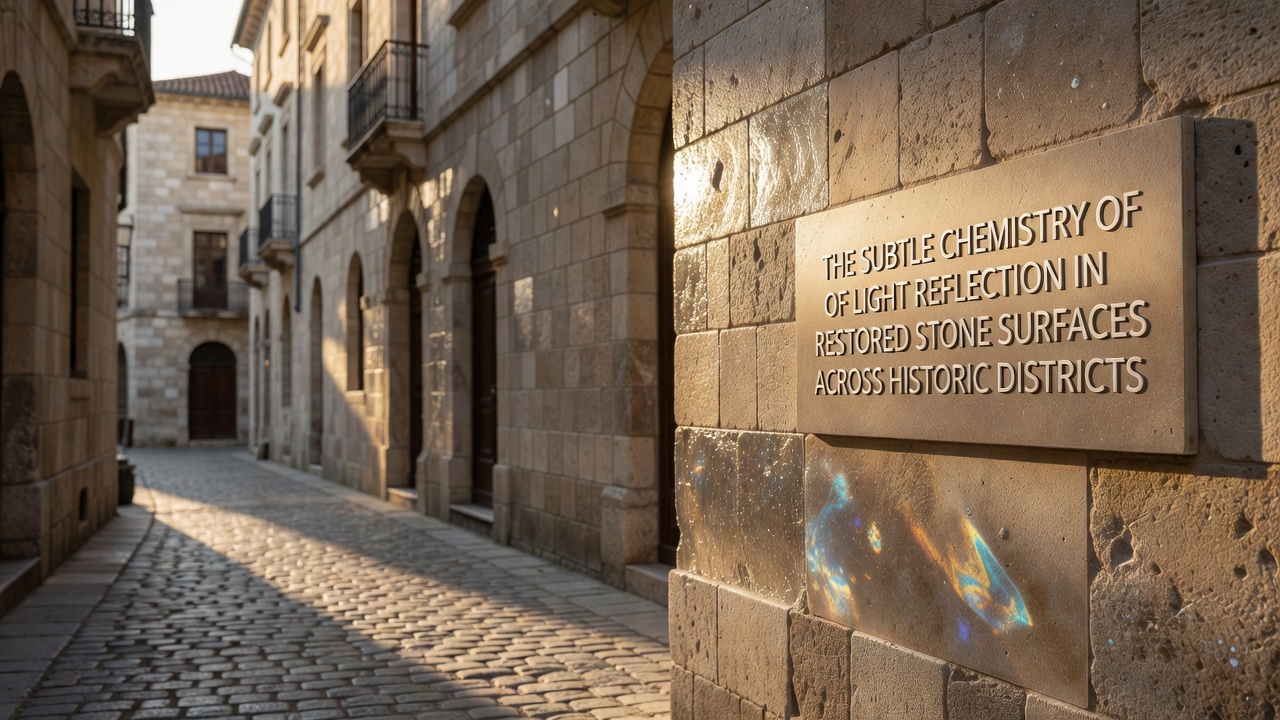
The Subtle Chemistry of Light Reflection in Restored Stone Surfaces Across Historic Districts
Restored stone surfaces in historic districts exhibit distinct light reflection behaviors that stem directly from changes in mineral chemistry during conservation work, and these alterations influence how buildings appear under varying daylight conditions throughout the year. Calcium carbonate based stones such as limestone and marble contain calcite crystals whose refractive index sits near 1.66, yet exposure to consolidants or cleaning agents modifies surface porosity and crystal orientation, which shifts the balance between specular reflection and diffuse scattering. Conservation teams apply ethyl silicate or acrylic copolymers to bind loose grains, and these treatments create a thin silica network that raises the effective refractive index at the surface while reducing internal light absorption.
Mineral Composition and Surface Alteration
Historic stones accumulate gypsum crusts from sulfur dioxide reactions with calcite, and removal of these layers exposes fresher mineral faces whose cleavage planes reflect light at different angles than weathered material. Researchers measure reflectance spectra before and after treatment using portable spectrometers, and data collected across multiple European sites show an average 8 to 12 percent increase in specular reflectance once gypsum is cleared and a consolidant is applied. The reaction products of ethyl silicate form amorphous silica that fills micro-pores, thereby decreasing subsurface scattering and producing a slightly higher gloss value that remains stable for decades when properly maintained.
Techniques That Modify Optical Properties
Laser cleaning systems tuned to 1064 nanometers ablate black crusts without disturbing underlying calcite, yet the resulting surface exhibits a measurable reduction in roughness that alters the bidirectional reflectance distribution function. In contrast, micro-abrasive methods leave microscopic striations that increase diffuse reflection and mute specular highlights, which explains why adjacent restored blocks sometimes appear mismatched under raking light. Observers note that pH-neutral poultices containing ammonium carbonate convert gypsum back to calcite in situ, and this chemical reversal restores some of the original crystal habit while leaving residual ions that affect long-term light absorption characteristics.
October 2026 will see the launch of a coordinated monitoring program across twelve Italian and Spanish historic centers where portable goniospectrophotometers will record seasonal shifts in reflected light from treated stone, and preliminary protocols already indicate that relative humidity cycles above 75 percent accelerate re-crystallization of soluble salts that further modify surface optics. Those measurements will feed into predictive models used by heritage agencies to schedule maintenance before visible changes in appearance become pronounced.
Regional Variations in Stone Response
Sandstone districts in northern Europe contain quartz and feldspar grains cemented by iron oxides, and restoration with silane-based water repellents coats these grains with a hydrophobic layer that increases forward scattering of shorter wavelengths, giving cleaned surfaces a cooler appearance under overcast skies. Australian heritage projects on Sydney sandstone have documented similar effects after application of fluoropolymer treatments, with spectral reflectance curves shifting toward higher values in the 400 to 500 nanometer range. Canadian conservators working on Manitoba limestone report that potassium silicate hardeners produce a denser surface film than European ethyl silicate products, resulting in stronger specular peaks when measured at 30 degree incidence angles.
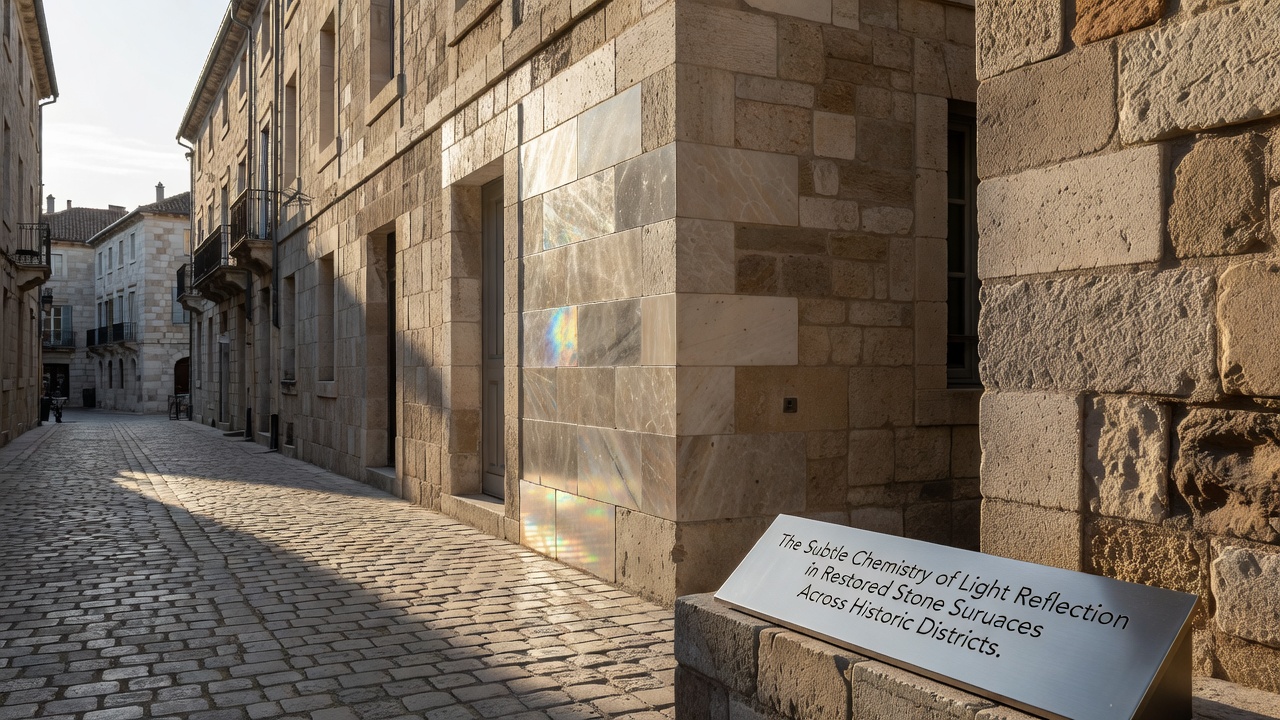
One study conducted by the Getty Conservation Institute tracked reflectance changes on treated travertine panels in a California mission courtyard over eight years, and results indicated that initial gloss increases stabilized after the third year once the consolidant fully cured and minor surface re-carbonation occurred. Those findings align with measurements taken on restored marble in Mediterranean climates where solar exposure accelerates the same curing sequence.
Light Interaction Mechanisms
Light striking a restored stone surface encounters both the altered mineral matrix and any residual treatment films, and the resulting reflection depends on the Fresnel equations modified by surface roughness parameters measured in micrometers. When roughness falls below the wavelength of visible light, specular reflection rises sharply, which accounts for the polished appearance of many recently cleaned facades. Conversely, incomplete removal of iron staining leaves sub-surface absorbers that reduce overall reflectance across the visible spectrum and produce warmer tonal shifts under direct sunlight.
Heritage organizations in the United States and the European Union maintain databases of reflectance spectra for common stone types before and after standard interventions, and these records allow conservators to match replacement blocks or predict how new repairs will integrate visually with surrounding fabric. The National Park Service technical guidance on stone preservation includes protocols for documenting these optical properties as part of routine condition assessments.
Conclusion
Chemical interactions during restoration directly govern how light reflects from historic stone, and continued monitoring programs scheduled to expand in October 2026 will supply additional quantitative data on long-term stability of these surface modifications. Accurate understanding of refractive index shifts, crystal reorientation, and porosity reduction enables more precise selection of treatments that maintain visual continuity across entire districts while protecting the underlying material from further weathering.